
 Japan With Adi
Chapter five of my Japan story: chosen by my classmates' votes, training after seven-hour school days, fixing my "Indian accent", a hand-sign memory trick, and the moment I thought I'd come third.

"Fix your Indian accent a little, Aditya." I heard that again and again while preparing for a Japanese speech contest at my language school in Japan. Here's the story, and the tricks that helped me win.
Chosen by blind vote 🗳️
One day our class teacher announced a speech contest. Every student in our class (about 10 to 12 of us) had to write an essay, and one would represent the class.
The selection was clever: everyone read everyone else's speech without knowing who wrote it, and voted for the best.
My topic: 笑顔の大切さ (egao no taisetsu), "the importance of a smile."
Many classmates studied harder than me and had great topics. But the next day the teacher said: "Aditya, you've been selected." My friend from Mongolia was shortlisted too. We were both stunned.
Training after seven-hour days 🏋️
We already had about seven hours of class a day. After that, our sensei took the two of us to a separate room for another one to two hours of training. My friend even quit his part-time job to focus.
I wasn't fully serious until she told me it was a matter of the class's pride. Then it hit me: I'd be representing India on that stage. Nervous, anxious and excited, all at once.
My friend's strength was vocabulary and kanji. Mine was that I'm talkative. That helped.
The two critiques
- "Your accent: please fix it a little." She'd pronounce each word at least ten times while I copied her. Sounding exactly like a native speaker is a next-level skill, but I improved what I could in those few days.
- "Too much energy." Japanese audiences like energy, but too much can feel unprofessional. Bring it to the middle. (My sensei in India had told me the same before my MEXT interview.)
Contest day 🎤
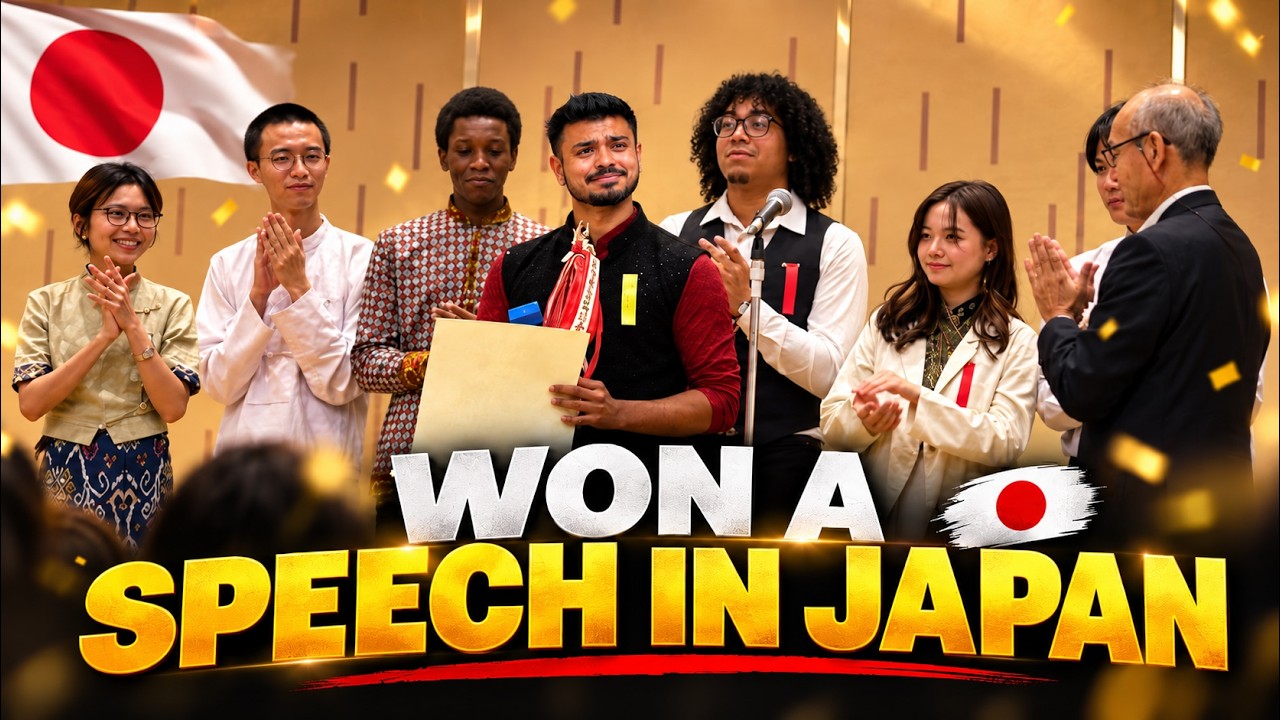
I wore a kurta, the only traditional outfit I had in Japan, to represent my country. Two minutes of pure Japanese in front of a hall full of people, for the first time in a foreign country. Even for an extrovert, that's nerve-racking.
Speakers went in order of class level. Before my turn, two of my competitors froze on stage. One stopped mid-speech, then pulled out a page and read from it. Watching that, my body went hot with anxiety. If that happens to me, I'm finished.
But I kept reminding myself: I've practised this so much. I trust my work.
When you practise something until you're truly confident, then however anxious you feel, you'll find a way to calm yourself.
My memory trick: hand signs ✋
I'd memorised the speech and knew the meaning of every word. But in a silent hall, if my flow broke, that silence would feel deafening.
So I used hand signs as keywords, one gesture for each paragraph. For example, a paragraph about building a bridge between countries had a "bridge" gesture, for 架け橋 (kakehashi). If I blanked, the gesture would unlock the next paragraph, like chapters on a YouTube video.
Gestures also make you look confident and help your brain organise ideas. I recommend it for any speech.
About 80% through, I paused for two seconds because I'd forgotten something, caught it instantly, and kept going. In the video you can't tell. But I felt a chill down my spine.
Arigatō gozaimashita. Applause. I walked off proud, but worried about those two seconds.
"I came third." Then the trophy 🏆
My Japanese wasn't yet good enough to follow the announcements fully. I thought they were handing out third-place certificates. Someone went up. Then someone else. Then: "Aditya Dewangan."
My heart sank. Third. In my head a battle raged: No, I'm first. I'm first. Please.
On stage they handed me the certificate, and then a trophy. I was in tears. Is this for me? I'd come first. My classmates' reaction was priceless.
Maybe it's just my perception, but this was the second time in my journey that refusing to accept the bad outcome seemed to turn things around. True or not, being persistent gives you a better mindset for life.
My Mongolian friend didn't win, but he was a champion on that stage, and the first to hug me. That's what friends are. That night we all ran to an Indian restaurant, and I emptied my wallet on the party.
What came after
My principal took me to give the same speech at four more places, including for the Rotary Yoneyama people, who gave me a certificate and a pen with my name engraved in katakana.
And on that trophy in Japan, there's still a ribbon with my name on it. Every year's winner gets one. That makes me happy: good, fond memories of student life in Japan. That's what matters.
Tips for your own Japanese speech ✅
- Pick a topic you feel, like the importance of a smile.
- Practise with a native speaker for pronunciation, repeating each word many times.
- Keep your energy calm and steady.
- Use hand signs as memory keys for each paragraph.
- Rehearse the small things: adjust the mic, bow, start.
- If you blank, keep going. The audience rarely notices.
Want to speak Japanese with confidence? Start with how to speak Japanese and our free course.
